
Cloaking Film for Glass Meeting Room Partitions
WINGO ·
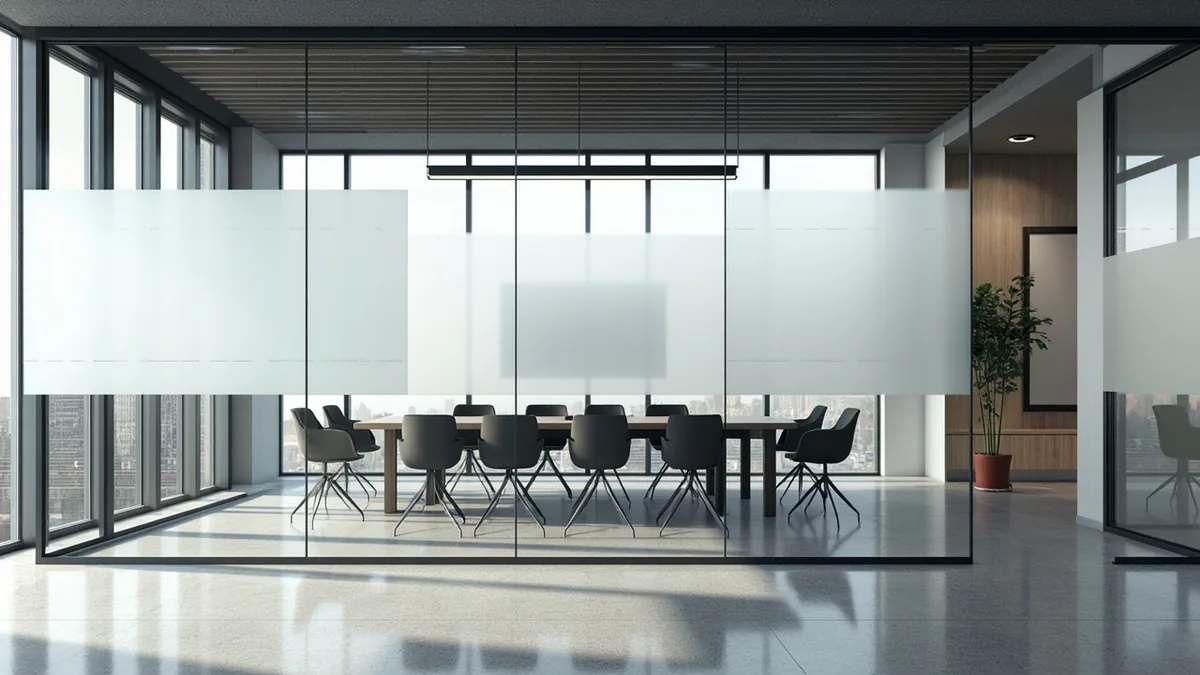
A practical guide to optical screen privacy on glass partitions, including display compatibility, viewing-angle limits, testing, and project confirmation.
What Cloaking Film Does
WINGO cloaking film is an architectural optical film applied to glass partitions. It is intended to obscure information shown on compatible digital displays when viewed from outside the meeting room, allowing occupants to collaborate while reducing visual exposure through the glass.
The appearance of the room remains generally normal, but screen visibility depends on the display technology, glass layout, viewing position, angle, lighting, and film orientation. Cloaking film is not an electromagnetic or acoustic privacy device, and it does not replace broader information-security controls.
Best-Fit Meeting Room Applications
The film is most appropriate where a glass wall separates a meeting room from walkways, offices, or shared work areas and a compatible display is positioned behind that partition. It can support visual privacy for presentations, internal collaboration, and discussions involving sensitive information.
It is designed for LED-backlit LCD displays rather than a direct-applied laptop or monitor filter. Smaller screens, many touchscreens, phones, and other device types may not be suitable. Screen size, position, brightness, viewing distance, and the surrounding glass arrangement should be reviewed before selection.
Limitations of Optical Privacy
Cloaking is angle-dependent, so an observer standing close to the glass and viewing at an extreme angle may still see more than intended. The film should not be expected to become fully opaque in every viewing situation. Changes in opacity are therefore a normal part of evaluating the optical result rather than evidence that the installation has failed.
A sample should be placed at several locations on the glass and checked from the intended outside viewing positions. This is especially useful for rooms where the partition is viewed from multiple corridors or seating directions.
Questions to Answer Before Ordering
Start by identifying every display that needs protection, its technology, approximate size, and whether it will sit near or behind the glass partition. Confirm the viewing path that must be obscured and note any competing requirements for room brightness, visibility, graphics, or interior openness.
Ask WINGO to confirm whether the specific display and proposed glass layout are suitable, and which installation orientation is required. Do not assume that a compatible display will behave identically in every room; installation conditions are part of the application, not just the screen itself.
Installation and Project Planning
The film is installed on the glass partition between the outside viewer and the display. Planning should include the partition dimensions, display location, viewing angles, surface condition, and any design elements that may affect appearance. Because appearance can vary across a room, reviewing a sample at relevant positions helps expose issues before a larger installation.
The supplied product information describes adhesive-backed architectural film with composite sealing and moisture protection. WINGO can advise on product suitability and project-specific installation requirements after the display and glass details are reviewed.
Talk With WINGO About Your Project
For a meeting room, office, or collaborative workspace, provide the display type, screen size, glass partition concept, and likely viewing positions when requesting guidance. WINGO can then help confirm compatibility and discuss whether a sample should be evaluated before proceeding. Invite the reader to discuss the project with WINGO for an application-based review.